
Homemade hair care can be simple, cheap, and genuinely useful if you use the right recipe for the right problem.
In this guide, I’ll show you the easiest DIY hair care recipes for dry hair, curly hair, itchy scalp, buildup, fine hair, and more, plus which ingredients are actually worth using and which ones are easy to overdo.

These recipes are quick, beginner-friendly, and based on common ingredients like honey, yogurt, aloe vera, coconut oil, and apple cider vinegar.
Some are best for moisture, some for shine, and some just for getting your hair to feel normal again after too many products.
This post may contain affiliate links at no extra cost to you.
In a Hurry? Start Here
- Dry, rough, or tangled hair: go to the Yogurt + Coconut Oil Mask
- Dry or curly hair: go to the Coconut Oil + Honey Conditioner
- Dry or sun-damaged hair: go to the Avocado + Coconut Oil Mask
- Dandruff or an itchy, oily scalp: go to the Tea Tree Scalp Treatment
- Dry hair that needs shine: go to the Castor Oil Conditioning Treatment
- Dull hair or light product buildup: go to the Apple Cider Vinegar Rinse
- Need a simple DIY shampoo: start with the Diluted Castile Soap Shampoo
Want more than a one-off treatment? See the Simple DIY Natural Hair Care Routine below to put these recipes together without using everything at once.
Simple DIY Natural Hair Care Routine
You don’t need to use all eight recipes. A simple homemade hair routine can be just cleanse, moisturize, clarify when needed, and take care of your scalp.
Here’s an easy way to build one:
- Wash day: Use the homemade shampoo when your scalp and hair actually need cleansing.
- After washing: Choose the honey-and-oil conditioner for curls, or the yogurt and coconut oil moisturizer for dry or rough hair.
- Once in a while: Use the build-up remover when your hair starts feeling coated, heavy, or dull.
- Dry or itchy scalp: Use the diluted tea tree and peppermint scalp oil only when needed.
- Fine hair: Keep heavy oils and rich masks mostly on the lengths and ends so they don’t flatten your roots.
- Very dry, curly, or damaged hair: Focus more on conditioning and less on frequent clarifying.
The important part is to adjust the routine to what your hair is doing, rather than following the same schedule every week.
Not sure where to start?
Most people will get the best first result from the moisturizer for dry hair or the build-up remover, because those solve the most common “my hair feels awful lately” problems.
Why Should You Make Your Own Hair Products?
I’ve been making some of my own hair products for years because I like knowing exactly what goes on my hair and scalp.
It also lets me keep the formulas simple, skip ingredients I don’t personally want, and save quite a bit of money.
With the money I save, I buy organic vegetables.
Plus, when I get compliments, I can finally say “I made this” – something I can’t say about my cooking.
The Best Ingredients for Homemade Hair Care
You really don’t need a cupboard full of ingredients to make useful hair products at home.
These are the ones I find most worth keeping around:
- Coconut oil – one of the better-studied hair oils. It can penetrate the hair shaft and reduce protein loss from damaged and undamaged hair. See the study.
- Rosemary oil – one of the few essential oils with human hair-growth research. In a trial of 100 people with androgenetic alopecia, hair counts increased after six months with both rosemary oil and 2% minoxidil.
- Tea tree oil – particularly useful if dandruff is part of the problem. A 5% tea tree oil shampoo improved dandruff scores by 41%, compared with 11% with placebo in this trial.
- Raw honey – useful in homemade masks and conditioners when you want extra moisture and slip.
- Aloe vera gel – a light option for adding moisture without loading the hair with oil.
- Castor oil – great for shine and a richer conditioning treatment.
What About Baking Soda and Apple Cider Vinegar?
I’d use these much more carefully.
Baking soda is highly alkaline, and alkaline products can increase friction, lift the hair cuticle, and make hair more prone to frizz and breakage (See research).
An occasional diluted acidic rinse can help counter alkalinity, but that doesn’t mean your hair needs apple cider vinegar every week.
8 Easy Homemade Hair Product Recipes
These homemade hair care recipes are low-cost, quick to mix, and based on simple ingredients many people already have at home.
1. Homemade Natural Shampoo
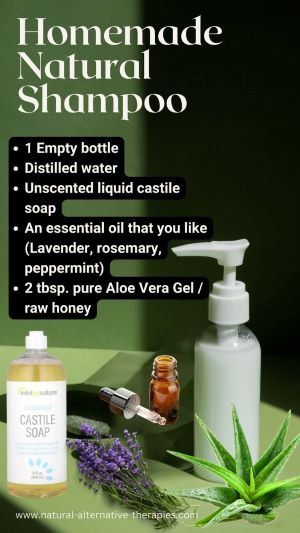
Best for: oily or normal hair that needs a simple occasional cleanse.
I haven’t bought a shampoo for over 5 years, and trust me, my hair does better with simpler formulas and fewer extras, especially when my scalp is feeling irritated.
If you want the simplest homemade shampoo possible, Castile soap is about as easy as it gets.
But there’s one thing I wish I’d known earlier: more soap is definitely not better for your hair.
Castile soap is alkaline, so I use it well diluted rather than mixing it half-and-half with water. Alkaline cleansers can increase friction between hair fibers and make hair more sensitive to frizz and breakage.
Ingredients
- ½ cup water
- Up to ½ tablespoon unscented liquid Castile soap
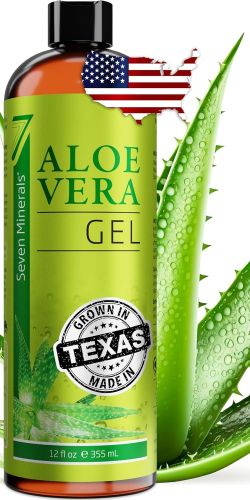
- Optional: 1 teaspoon aloe vera gel
- Optional: 1–2 drops rosemary or lavender essential oil
(If you use store-bought aloe, choose one with minimal additives)
Instructions
Mix a small amount fresh before washing. Apply mainly to your wet scalp, massage gently, and rinse thoroughly.
If your hair is dry, curly, bleached, colored, or already damaged, I wouldn’t use this as an everyday shampoo.
A gentle pH-balanced shampoo is usually a better choice.
And because diluted Castile soap doesn’t keep as well, I prefer making enough for one or two washes rather than storing a big bottle
Fill your bottle with equal parts distilled water and Castile soap. Then add a few drops of your favorite essential oil and the aloe vera gel.
Gently shake the bottle to mix all the ingredients, and you’re ready to go.
2. Homemade Hair Conditioner for Curly Hair
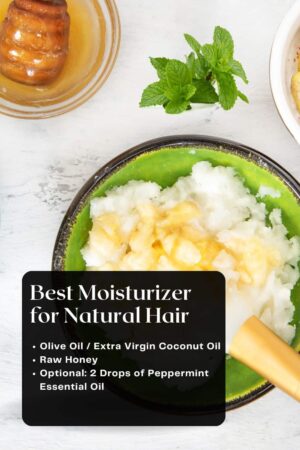
Best for: dry curls that need extra softness and moisture
If your curls feel dry or rough, this is one of the easiest masks you can make.
Coconut oil is especially good for damaged hair because it can penetrate the hair shaft and reduce protein loss (study)
Ingredients
- 1 tablespoon coconut oil or olive oil
- 1 tablespoon raw honey
- Optional: 1 drop peppermint essential oil
Instructions
Mix the oil and honey, then work a small amount through damp hair, concentrating on the mid-lengths and ends.
Cover with a shower cap, leave for about 20 minutes, then rinse and shampoo if needed.
If your curls are fine or get weighed down easily, start with less oil and keep it away from the roots.
Thick, very dry curls can usually handle more.
3. Homemade Moisturizing Hair Mask
Best for: dry, rough, or damaged-feeling hair.
This is one of my favorite masks when my hair feels dry and impossible to detangle.
The ingredient with the best research behind it is coconut oil. Unlike many oils that mostly sit on the surface, coconut oil can penetrate the hair shaft and has been shown to reduce protein loss from both damaged and undamaged hair
This yogurt hair mask will make your hair manageable and tangle-free in 30 minutes max, and it works for all hair types too.
Choose this if your hair feels rough, snags after washing, or gets puffy and dry by the next day.
Ingredients
- ½ cup plain yogurt
- 1–2 tablespoons coconut oil
- 1 tablespoon raw honey
Instructions
Mix everything together and work it through damp hair, concentrating on the lengths and ends.
Leave it on for about 20–30 minutes, then rinse well and shampoo lightly if needed.
If you have fine hair, start with just 1 tablespoon of coconut oil. If your hair is very dry or coarse, you may prefer a little more.
I use yogurt here mainly because it makes a creamy, easy-to-spread mask.
4. Beer Treatment for Limp or Fine Hair

Best for: fine hair that falls flat and needs volume.
To add body and volume to limp or dry hair, you only need a surprising beauty beverage: Beer.
Beer contains a lot of yeast, which plumps tired or flat-looking hair, and is much healthier when used on the hair than inside your liver.
Ingredients
- 1/2 cup beer
- 1 tsp olive oil
- 1 raw egg
Instructions
Mix 1/2 cup of flat beer (beer that’s been “sitting” out for a few hours) with 1 tsp olive oil and 1 raw egg.
Apply to your hair when it’s clean and damp, and let sit for 15 minutes (wrapped in a shower cap), then rinse with cool water.
When the liquid evaporates, the remaining protein will strengthen and structure your hair.
Now take a sip from your beer and enjoy the extra volume in your hair.
5. Moisturizing Mask for Dry or Sun-Damaged Hair

Best for: dry, brittle or sun-exposed hair
Sun really can damage your hair. UV exposure has been shown to damage hair proteins and increase protein loss (see study).
But I wouldn’t say eggs “repair” keratin or make new hair grow. We don’t have good human evidence for that.
For this mask, I’d keep things simpler.
Ingredients
- 2 tablespoons mashed avocado or egg yolk
- 1 tablespoon raw honey
- 1 tablespoon coconut oil
Instructions
Mix everything until smooth and apply mainly to the lengths and ends of damp hair.
Leave it on for about 20 minutes, then rinse well and shampoo if needed.
6. Tea Tree Treatment for an Itchy, Flaky Scalp
Best for: dandruff and an itchy, oily scalp.
Tea tree oil is one DIY ingredient that actually has some decent human evidence behind it.
In a randomized trial, a 5% tea tree oil shampoo improved dandruff scores by 41% after four weeks, compared with 11% with placebo. It also improved itching and greasiness.
Ingredients
1 tablespoon coconut or jojoba oil
A small amount of tea tree essential oil, diluted according to the bottle directions
- A few drops of Tea Tree oil and Peppermint oil
- Raw Coconut Oil
( Read: 38 Home Uses for Tea Tree Oil)
Instructions
Massage it gently into your scalp, leave it for about 15–20 minutes, then shampoo it out.
Tea tree oil can irritate sensitive skin. Patch-test first, never use it undiluted, and never swallow it.
👉 If itching, flakes or dryness are your main problem, see my complete guide to home remedies for a dry, itchy scalp. It covers tea tree oil, honey, aloe vera, and the common reasons scalp irritation keeps coming back.
7. Castor Oil Conditioning Treatment
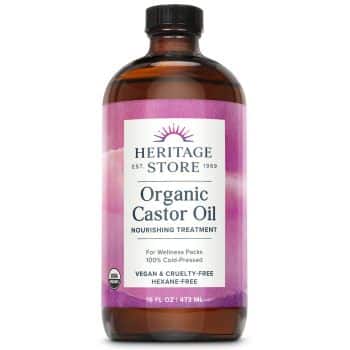
Best for: dry hair, shine, and reducing the look of breakage.
Castor oil is one of my favorite heavier oils when hair feels dry, fragile, or tends to break.
I like using it because it’s thick, rich, and works nicely as a conditioning oil.
I’ve also personally used it on my eyelashes and eyebrows, but that’s my experience, not proof that it causes regrowth.
I’ve used it to regrow a part of my eyelashes, burned a bit by a rebellious lighter. I also use castor oil on my face overnight.
Ingredients
- Castor oil
- 1 tablespoon coconut, jojoba, or almond oil
Instructions
Mix the oils and massage a small amount into your scalp and hair.
Leave it on for 30 minutes, then shampoo well. If your hair is very dry or coarse, you may prefer leaving it on longer.
👉 If you’re mainly interested in castor oil for thinning or breakage, I go much deeper into how to use Jamaican black castor oil for hair growth, including what it can realistically do, how often to use it, and where the evidence is still weak.
8. Diluted Apple Cider Vinegar Hair Rinse
Best for: hair that feels dull or coated.
If you’ve been using industrial hair products for a while, you may have some product buildup on your scalp.
Other than it being unhealthy, at some point, it’ll be like trying to comb through a bird’s nest, and nobody wants that kind of headache.
So, for good hair days and to save your hairbrush from becoming a chew toy, it’s best to remove hair product buildup every now and then.
Ingredients
1–2 cups water
1 tablespoon apple cider vinegar
Instructions
After shampooing, pour the diluted mixture through your hair, avoiding your eyes.
Leave it for a minute or two, then rinse thoroughly.
I’d use this occasionally rather than after every wash, especially if your scalp is sensitive.
👉 Activated charcoal is another ingredient commonly used in clarifying hair and scalp products because it can adsorb surface oil and buildup. See the other practical uses for activated charcoal here.
What Damages Your Hair the Most?
You can make all the hair masks you want, but avoiding damage in the first place makes a much bigger difference.
The habits I’d watch most are:
1. Too much heat – Flat irons, curling irons and very hot blow-drying can damage hair proteins and increase breakage.
Use the lowest heat that works and give your hair days off from heat styling. (See the research)
2. Bleaching, relaxing and repeated chemical treatments – Hair dye, bleach, perms and chemical straighteners can leave hair drier and more fragile, especially when several treatments are combined.
3. Rough handling – Aggressive towel drying, brushing tangled hair, and tight hairstyles can all increase breakage.
Be especially gentle when your hair is wet.
4. Too much sun – UV exposure can damage keratin, fade color, and increase protein loss from the hair shaft. (See the research)
5. Harsh or very alkaline cleansers – Higher-pH cleansers can increase friction between hair fibers, which can mean more frizz, cuticle damage, and breakage.
Making your own hair products is cost-effective, money-saving, and, best of all, free of cancer-causing additives and chemicals found in commercial hair care products.
DIY Hair Care FAQ
What is the Best Homemade Hair Treatment for Dry Hair?
A richer mask made with ingredients like yogurt, honey, coconut oil, or avocado is usually the best DIY option for dry hair because it adds slip, softness, and temporary moisture.
Which DIY Recipe is Best for Curly Hair?
A simple honey-and-oil conditioner is usually the best starting point for dry curls because it adds softness without turning the routine into a full project.
What is the Best DIY Treatment for Hair Buildup?
An occasional clarifying rinse or buildup remover is the best choice when hair feels coated, heavy, or dull from too many products.
Can Essential Oils Help Hair Grow Faster?
Some essential oils (such as Rosemary Oil) are popular in hair-growth routines, but the evidence is limited, and they should be diluted and patch-tested carefully before use.
To your health and happiness,
Meital

Of course, any recipe can be doubled and put into a larger bottle 🙂
I love the idea of all natural hair products. Your recipe for shampoo is a large bottle. Is there a way to make up the other products in large quantities for the shower? We all work and to do this one by one wouldn’t be sustainable.
Thanks so much for sharing this wonderful information
Betty,
Personally I use the aloe and not the honey. It’s great!
I would like to make the homemade shampoo. Do you use aloe and raw honey in the recipe?
Jamie,
Infused oil is less potent than a essential oil, but if you have it at home already, why not give it a try? 🙂 Good luck!
So simple and inexpensive! I was curious. I almost never use rosemary, though I am considering adding it to my fall/winter hair regimen. In you opinion would I get the same benefits from an INFUSED rosemary oil opposed to purchasing essential rm oil?
Brandy,
No, not a silly questions at all…
Generally it depends on how much hair you have…
I would start out with 2 tsp oil and 1 tbsp honey.
Hope this helps and come back to let me know how it worked for you o.k?:)
Thank you so much im looking foward to trying these out!! One question,For the curley hair recipe.. what is the olive oil honey amounts to use? Sorry if this seems to be a silly question 🙂
Thanks for the great post! I chose it for my featured post this week at the From the Farm Blog Hop! I hope you’ll be back to share with us! 🙂
~ Christine
Mamie,
I’m so glad you like it! Thanks for visiting!:)
Dear Meital, Thx for the great natural hair conditioner and shampoo recipes.All your natural ideas are wonderful and inspiring! God bless!
Mamie
Deborah,
Great to see you here again!!
Thanks for taking the time to comment and share…you rock!
These natural hair care recipes are just what I love! It is amazing how effective, low-cost and toxin-free these DIY solutions are. Thanks for sharing. I use coconut oil, castoroil, apple cider vinegar and other kitchen ingredients for hair care as well. I am pinning and sharing.